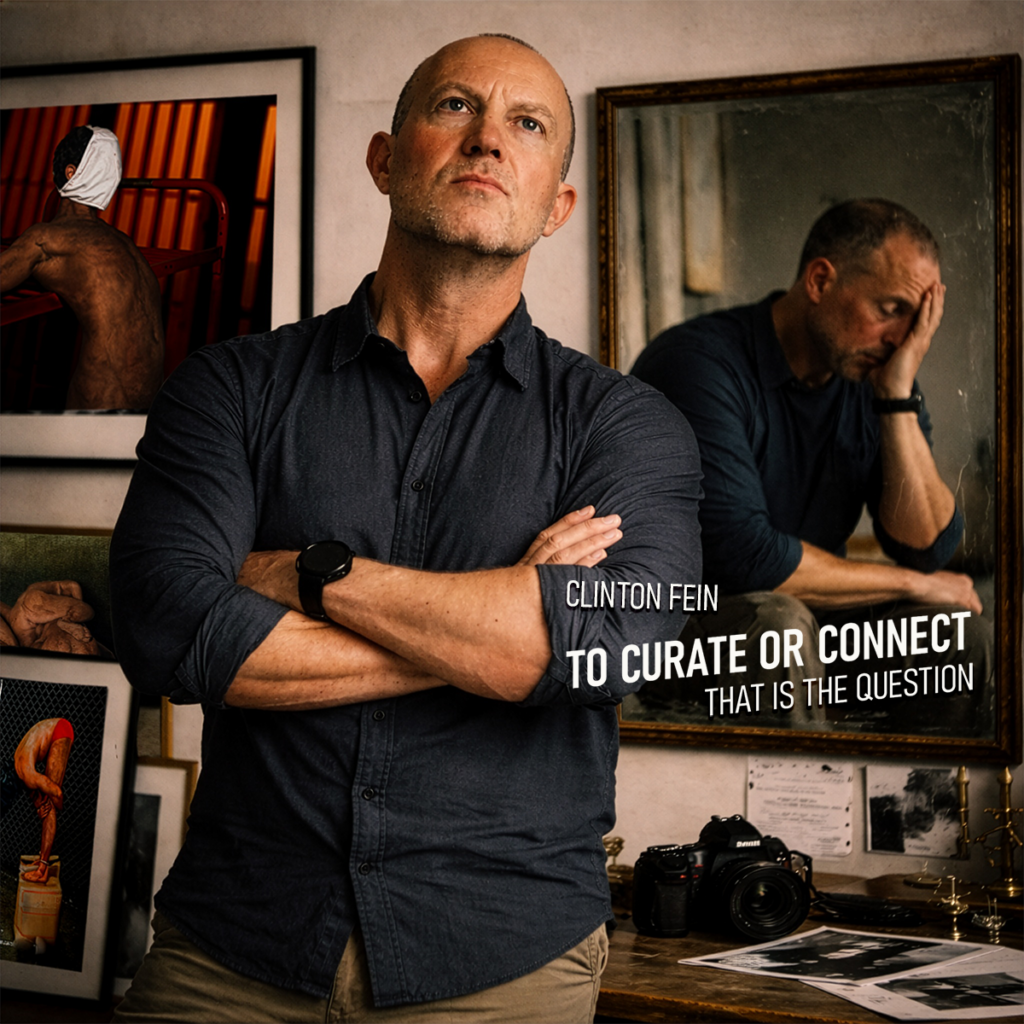
To Curate or Connect. That Is The Question.
Marc Andreessen, the venture capitalist whose entire fortune is built on betting on other people’s ideas, recently went on David Senra’s podcast and declared that he aims for “zero” introspection. Not minimal introspection. Not balanced introspection. Zero. “As little as possible,” he clarified, as if we needed the fucking qualification. “I found people who dwell in the past get stuck in the past,” he pontificated with the confidence of someone who has never had to genuinely reckon with a consequential mistake. “It’s a real problem. It’s a problem at work, and it’s a problem at home.”
He then dismissed introspection as some toxic cocktail of neuroticism, narcissism, and “thumbsucking.” Elon Musk, naturally, chimed in with his agreement. Two billionaires high-fiving each other over their shared commitment to never examining their own choices or learning from their mistakes.
I’ve been writing a memoir, Nothing in Moderation, for almost a decade. It will finally be completed this year. And yes, I’ve been doing plenty of other things during that time, because contrary to Andreessen’s reductive framing, introspection doesn’t require you to curl up in a ball and stop functioning. Memoir writing requires honest, sometimes brutal self-examination. It demands that you revisit decisions you made, relationships you fucked up, moments when you were wrong, and patterns you’d rather not acknowledge.
There’s a massive difference between dwelling in the past and learning from it. Dwelling is paralysis. Getting stuck in regret, replaying scenarios endlessly without growth or movement. Learning is active. Examining what happened, understanding why you made certain choices, recognizing patterns, and using that knowledge to make better decisions going forward.
What Andreessen is really advocating for isn’t efficiency or forward momentum. It’s intellectual and emotional laziness dressed up as productivity. It’s the philosophy of someone so convinced of their own brilliance that the idea of examining their failures feels like a waste of time. What’s more narcissistic than assuming your first instinct is always correct? What’s more self-absorbed than believing your decisions require no examination because you’re simply that fucking smart? Andreessen’s philosophy guarantees you’ll remain exactly as wrong as you’ve always been, just with more confidence.
Andreessen’s position also requires a level of arrogance that’s almost breathtaking. You have to be so overopinionated, so convinced of your own infallibility, so fundamentally unfamiliar with genuine accountability, to believe there’s nothing to learn from your mistakes. To believe there’s no new insight to gain by training a different lens on a prior decision. To believe the person you were five years ago had it all figured out and requires no examination.
Jesus Christ, imagine being in a relationship with someone who considers self-reflection a character flaw. Someone who never examines their behavior, never questions their assumptions, never considers how their actions affect the people around them. Awesome, perhaps, if your idea of a partner is a narcissistic nightmare wrapped in productivity metrics.
As I’ve looked back on my work as an artist, and how it was digested, almost every review or article framed it as controversial. With good reason. The imagery I created in the aftermath of the attacks on September 11th, for instance, resulted in death threats. Images I created during the war in Iraq so incensed the printers that they physically and deliberately destroyed them before an exhibition opening in San Francisco. My Torture exhibition stirred fraught debates about the role of art, the ownership of trauma, and the glorification of violence.
I never sat down thinking, How do I make this provocative? How do I shock people? I was drawn instead to what felt urgent and unavoidable to me: homoeroticism in the military, raw and inescapable politics, torture, the things people would rather keep out of sight and certainly out of the living room. Themes that already had voltage running through them before I ever showed up. Critics would often reserve their harshest criticism for me rather than the work, questioning my motives, dissecting my choices, describing me as brave, stupid, attention-seeking, or manipulative for choosing themes so confrontational, so unfriendly, so destabilizing, and impossible to neutralize. At the time, I may even have bought into some of that framing. I convinced myself this was artistic integrity. That I was uncompromising and, yes, brave enough to look directly at what others preferred to ignore. And although there was an element of truth in that narrative, I’ve come to understand, years later, with the uncomfortable clarity that only time and distance provide, fear was involved too.
I was also hiding.
There is a particular safety in making art that arrives armed. Work that is abrasive, confrontational, and deliberately difficult does not simply risk rejection; it scripts it. It bakes criticism into the encounter. If the work is designed to repel, upset, provoke, and challenge, then rejection no longer feels personal. It feels inevitable. Controlled. Even useful. And that is a very different thing from standing exposed.
That kind of rejection validates. It’s something else entirely to be rejected for being vulnerable, for showing the soft parts without any protective coating of shock value.
I didn’t understand this about myself then. I believed I was fearless, confronting difficult subjects while other artists played it safe. But I was embedding vulnerability-proof defense mechanisms into every artistic creation. Well-executed, politically charged, aesthetically sophisticated, intellectually rigorous defense mechanisms.
That is why, when I saw The Opera Singer last week at Daphne Kuhn’s Theatre on the Square in Sandton, it stayed with me so powerfully. A play written by Janna Ramos-Violante about an obituary writer tasked with profiling a legendary opera diva who inspired his passion for opera. Fiona Ramsay and Owain Rhys-Davies gave extraordinary performances that lingered long after the final bows. Certain performances do that. They don’t end when the lights come up. They keep unfolding inside you because they’ve attached themselves to something you weren’t planning to examine.
What lodged itself deep in me was how brilliantly they embodied the play’s central tensions: the difference between who we are and who we project. Between person and persona. Between need and desire. Between being adored and being loved.
That distinction, especially, kept circling in my mind. Adoration can be built on spectacle, mystique, or persona. Love asks for something much less controllable. It asks to encounter what is uncurated.
It is also why the performance felt like a mirror held up at the exact angle I usually avoided. When we create personas, we gain the privilege of editing ourselves. We can curate out the parts that are messy, unguarded, insecure, or ashamed. Fiona’s layered and thought-provoking portrayal of the diva caught in that collision –between who she actually was and who she’d meticulously cultivated and revealed — felt almost uncomfortable in its intimacy. She moved between performance and exposure, between self-mythology and self-recognition, with such conviction that at times it felt less like watching a fictional character than witnessing an autopsy of persona itself.
It reminded me, in some ways, of the dysfunctional relationship between Princess Diana and the media. A toxic symbiosis and ever-shifting power imbalance driven by existential co-dependence. Owain’s Theo Harrington captured the media’s oily reverence, the false servility, the intimacy that is never intimacy at all because it is always in service of power. The power not merely to witness a life, but to shape its meaning through omission, framing, repetition, and ink. To adore openly and deform privately. To expose rather than reveal. To unmask rather than empathize. To make legible while erasing entirely.
As artists, as storytellers, as performers, as human beings navigating a world that now demands constant self-presentation, we build personas because personas are useful. They help us survive. They let us control the narrative, decide what to reveal and what to conceal. We make style out of wound, spectacle out of fracture. Even vulnerability can be performative if it’s shaped correctly, lit properly, filtered just so, and offered at the right angle to maximize impact while minimizing actual exposure.
But there’s always something omitted. The less elegant truth. The need beneath the projection. Something ugly, needy, unphotogenic, unlanguaged. The raw and frightened parts that don’t read well in artist statements, don’t frame well in gallery spaces, and don’t win applause or critical acclaim.
The Opera Singer illuminated why my current project with Bryan Schimmel, Bully Dialogues, feels so different. The bully is easy to condemn. Easy to position against. Easy to frame as the villain and leave it there. But our piece won’t enable that. It starts complicating the moral architecture almost immediately. It builds empathy where outrage would be easier. It refuses the cheap satisfaction of simplification. Although I wouldn’t call the piece easy for Bryan, because it’s far from it, his ability to allow himself to be vulnerable is more seasoned. From my point of view, it asks me for something I have spent much of my creative life avoiding with enormous skill.
It asks me to be vulnerable without the shield of provocation. It asks me to stand inside material that doesn’t protect me by being controversial or politically explosive. It asks me to risk something attack never really touched. It asks me to risk indifference. Misunderstanding. Emotional nonresponse. The possibility that if I remove the armor, there may be nothing underneath that compels anyone at all. No spectacle. No scandal. No morally charged argument to animate the room. Just a more naked truth. It asks me to risk being seen without first making myself untouchable through shock value or confrontation.
It challenges me to connect rather than curate.
A gift unavailable without introspection.
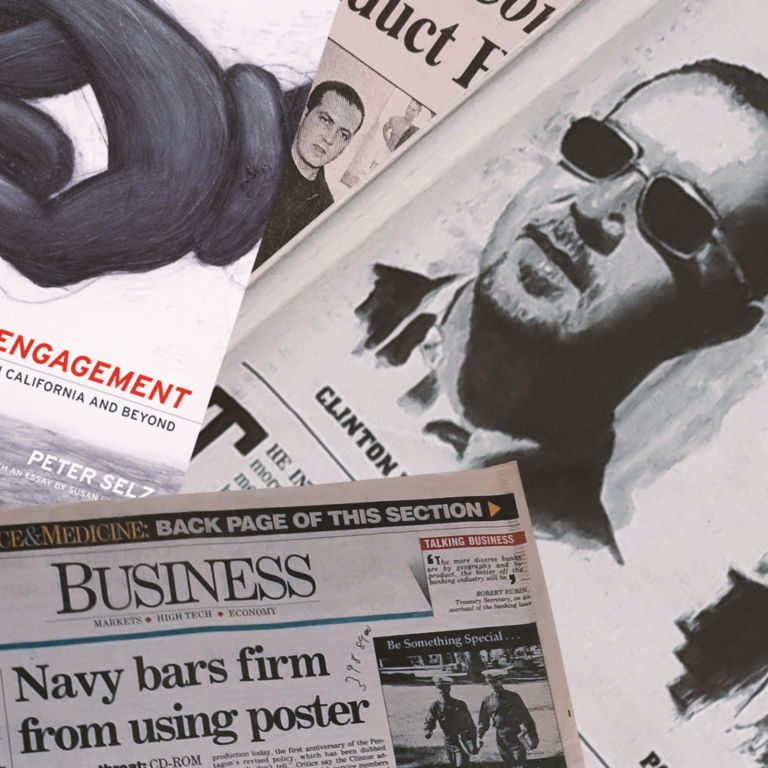
Select articles, news coverage and books from a plethora of publications covering Clinton Fein’s career as a technologist, activist, artist and speaker.
As an activist, with a Supreme Court victory over the Attorney General of the United States, Fein garnered international attention, including The New York Times, CNN and The Wall Street Journal.
Fein’s thought-provoking and controversial work as an artist caught the attention of prestigious educational institutions, including Harvard University, which recognized its socio-political relevance and ability to provoke crucial conversations about human rights, morality, and the boundaries of artistic expression.