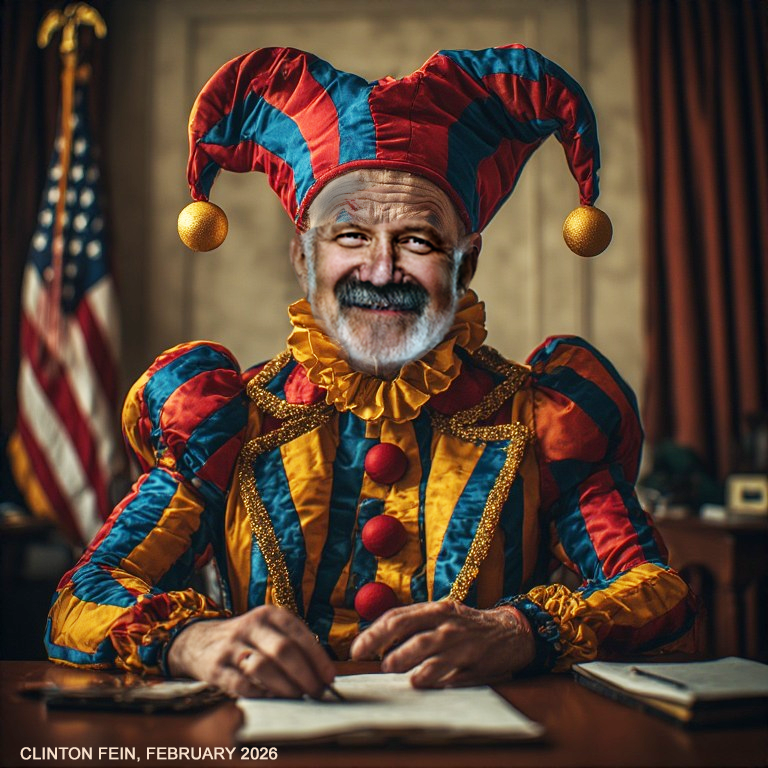
The Indestructible Leverage of Howard Lutnick
If humiliation were renewable energy, Commerce Secretary Howard Lutnick could power the northern hemisphere.
Most of the sycophants orbiting Donald Trump grovel like jilted sisterwives competing against child-wives for the same volatile husband. Little Marco Rubio, surgery-botched, puppy-killing Kristi Noem, shrill, crucifix-abusing Pam Bondi, over-gelled, alcoholic rapist, Pete Hegseth, knee-high, Joseph Goebbels wannabe Stephen Miller and mealy-mouthed, balls-deficient Scott Bessent stand out, but Lutnick’s degradation breaks the fucking sound barrier. The desperation is kinetic. He doesn’t merely stand behind Trump. He tilts toward him, like gravity has been recalibrated to favor narcissism. The grin is too wide. The nod too eager. The laughter detonates half a second before the punchline exists.
However, Lutnick’s ass-kissing, boot-licking theatrics are all about survival.
Cabinet meetings have devolved into state-sponsored exercises in verbal self-immolation. Grown adults in expensive suits competing to see who can metabolize humiliation the fastest by feeding the ego of the Pedo in Chief. And there’s Lutnick, vibrating with pick-me urgency, eyes darting, leaning forward as though devotion itself might evaporate if not constantly and visibly demonstrated. The stench of degradation is palpable.
Trump rambles incoherently; Lutnick beams like a Catholic priest at a choir boy retreat. Trump bullies; Lutnick cackles like Ed Gein in a cemetery. Trump drags an entire demographic through the mud; Lutnick erupts with the glee of little MAGA Mike Johnson poring over his son’s porn history.
The reaction is too fast to be genuine. It’s reflexive. Pre-programmed. The body language of someone who understands that proximity to power is defensive rather than decorative. Fear explains some of it. But fear alone doesn’t generate that level of manic enthusiasm. Fear produces caution. This produces theater.
For years, Lutnick spun a bullshit, conveniently moral bedtime story about Jeffrey Epstein. Epstein showed him a massage room. Said something creepy. Got too close. Lutnick recoiled. Six to eight steps from Epstein’s townhouse to his own, he and his wife decided, presciently, piously, cinematically, that he would never again be in a room with that man. A clean exit. Narrative sealed.
Then the latest tranche of Epstein files surfaced, along with emails from Lutnick to Epstein.
Not rumors. Not anonymous whispers. Emails. Dates. Boats. Lunches. Dinners. Children. Families. Cheerful logistics arranging visits to Epstein’s island years after Lutnick claimed he’d cut ties. His wife breezily describing eight kids in tow, bizarrely including their ages and genders. Lutnick himself asking about timing, captains, coordinates, like this was just another networking weekend with a particularly radioactive billionaire. And then the quiet little dagger: “Nice seeing you.”
Undeniable and corrosive contradictions, exposing Lutnick as a cheap, cloying liar.
In today’s power economy, unlike lies alone, contradiction is fatal because it destabilizes narrative, and narrative is the scaffolding holding reputation upright.
That’s where Lutnick’s panic lives. Not in what happened, but in what can be proven inconsistent beyond reasonable doubt. A man scrambling to stay inside the shelter of Donald Trump, who, until the release of the Epstein files, specialized in reframing scandal as persecution.
But here’s where the architecture shifts.
Epstein was connective tissue. Social currency. A clearinghouse of powerful men who now all insist they barely knew him, even as a slow-drip of information from the files keeps contradicting their denials and protestations. Frolicking in Epstein’s orbit lulled participants into a false sense of security, embedding its members within a cartel of leverage. Anyone who spent real time in that orbit, anyone arranging dinners, island visits, and logistics, accumulated memory.
And memory, in compromised ecosystems, is currency.
Because the same emails that embarrass Lutnick sit in the same historical swamp as Trump’s own documented associations. The same social circles. The same proximity to Epstein’s money and myth. If contradiction is dangerous for Lutnick, it’s potentially explosive for Trump. And culprits like Trump do not fire people who understand the wiring of the bomb.
Trump tolerates Lutnick not because he’s impressed by the obsequiousness, though he undoubtedly relishes it, but because in a world where everyone has something to lose, the safest ally is the one who loses if you fall. A contagious mutual entanglement that threatens to penetrate the cocoon of protection that has, to date, immunized Trump from accountability, along with every child-raping scumbag of whom only Jeffrey Epstein and Ghislaine Maxwell have paid a heavily discounted price.
So Lutnick laughs.
Each laugh is a transaction. Each grin a down payment. It’s signaling. I know what I know. You know what I know. If you throw me under the bus, you may as well throw yourself under it as well.
Trump’s protection may be conditional, but so is his vulnerability. You don’t casually kick someone to the curb who has seen the guest list, shared the dinners, shared the massage tables, shared the children, and relied on the assumption that association with Epstein was bulletproof protection available only to the elite, that opened doors, not investigations and unredacted documents.
And that’s why Lutnick’s performative humiliation is so baroque. It’s theater layered on theater. Lutnick performs his humiliating abasement to reassure Trump of loyalty. Sorely lacking the “central casting” looks that Trump prioritizes over competence, Trump tolerates Lutnick’s lies because expelling him would invite questions neither wants asked too loudly. But there is blood in the water and sharks are circling.
Whatever did or didn’t happen on Epstein’s island will eventually dissolve into footnotes and disclaimers. What remains is the spectacle: a cabinet secretary grotesquely groveling like a court jester who both fears and protects the king. A father broadcasting to his children that dignity is negotiable, that power is transactional, and that survival in America’s upper echelons requires a flexible relationship with truth and a full-scale rejection of basic morality.
Two of Lutnick’s sons, Brandon and Kyle, only in their twenties, spent childhood vacations along with siblings and nannies being entertained on Epstein’s island. Entitled Nepo babies who now helm Cantor Fitzgerald. Inheritors of a firm that once symbolized tragedy and resilience after losing 658 employees atop the North Tower of the World Trade Center on September 11th. They must now preside over a brand forced to reconcile survivor mythology with the lingering stench of Epstein’s fortune and legacy and the optics of political sycophancy. And when they look to their father for guidance, what do they see?
A pathetic excuse for a man laughing through degradation. Nodding along to cruelty. Demonstrating that the path to safety has nothing to do with integrity but is all about proximity. And that proximity is maintained as much by loyalty as by shared secrets. And that the pursuit of pleasure, power and profit justifies turning a blind eye to men who rape nine-year-olds.
That lesson metastasizes. Not because of a single island visit. Not because of one contradictory anecdote. But because the operating principle becomes undeniable: power is not about virtue. It is about leverage. About whom holds reciprocal vulnerability.
So Lutnick laughs harder.
This is what late-stage America looks like when fear and mutual blackmail underpin the political power structure. Billionaires clinging to presidents. Presidents clinging to billionaires. Men shielded by money, bound together by shared vulnerability to exposure, not political alignment.
America’s already tainted reputation and eroded moral authority collapses in a cabinet room full of crucifix-clutching pedophiles, protectors, and enablers, fawning and flattering with unprecedented, shameless obsequiousness and hollow laughter that is anything but funny.
Howard Lutnick, with his frozen rictus grin, isn’t just a supplicant paying for protection. He’s a stakeholder in the silence. A morally bankrupt little man who laughs loudly enough to prove loyalty, and falsely enough to remind everyone that he knows where the bodies are buried.
He won’t be fired because he’s indispensable. It’s because he’s compromised and dangerous. And in Trump’s disgustingly corrupt regime, reputational deterrence through mutual entanglement is the only real job security there is.
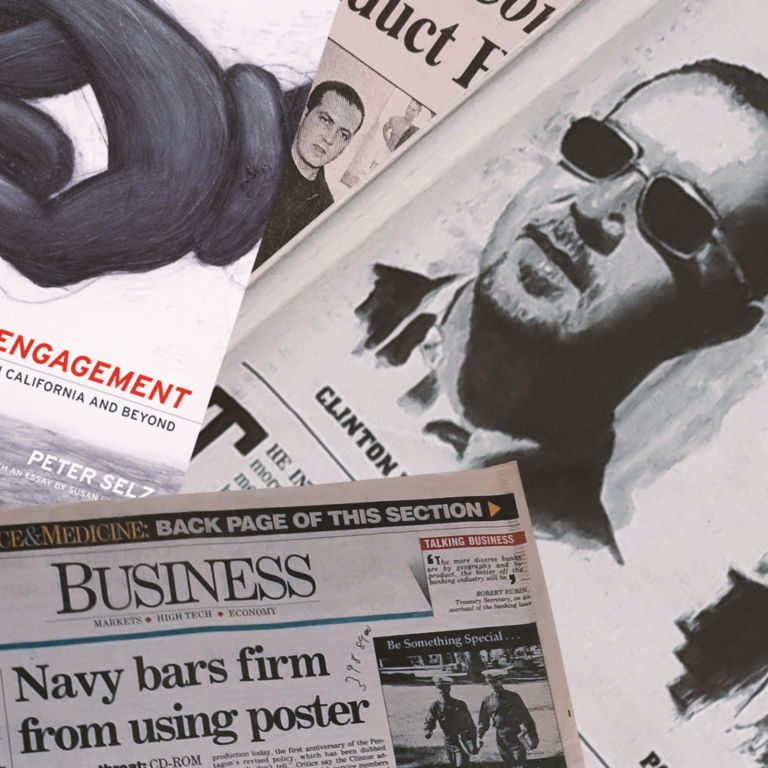
Select articles, news coverage and books from a plethora of publications covering Clinton Fein’s career as a technologist, activist, artist and speaker.
As an activist, with a Supreme Court victory over the Attorney General of the United States, Fein garnered international attention, including The New York Times, CNN and The Wall Street Journal.
Fein’s thought-provoking and controversial work as an artist caught the attention of prestigious educational institutions, including Harvard University, which recognized its socio-political relevance and ability to provoke crucial conversations about human rights, morality, and the boundaries of artistic expression.