
Of Course There’s a Damn War Plan
In the long and proud tradition of military strategy, great victories are rarely accidents. They require preparation, discipline, and a carefully executed plan. Which is why it is only fair to acknowledge that Donald Trump clearly had one for a war with Iran. In fact, when you step back and look at the sequence of decisions, it begins to resemble a remarkably well planned strategy. Much of which was influenced by Russell Vought, the Christian Nationalist who co-founded Heritage Action, the authors of Project 2024. A charming little man, in a Stephen Miller sense, and who now heads the Office of Management and Budget. No one is mentioning him right now, but he deserves a lot of credit for much of this ingenious ten-point plan. Along with Elon Musk.
This is the plan in all its brilliance.
Start by decimating relationships with your closest allies. Spend years insulting, threatening, and undermining governments that have historically stood beside the United States in moments of crisis. Treat these alliances as transactional nuisances instead of strategic assets. When the time comes to ask for support, expect magnanimity, now that the trust that once sustained those partnerships has been steadily eroded.
Next, destroy goodwill around the world by dismantling the humanitarian programs that once represented the most visible expression of American compassion. Close the clinics, slash food assistance, and eliminate the development programs that helped prevent disease and starvation in vulnerable communities. Soft power is like DEI. So what if it takes decades to build and only moments to destroy. When people watch their most vulnerable family members die from starvation and preventable causes, they remember who withdrew the help and are eternally grateful.
Then hollow out the State Department by pushing out the experienced diplomats who spent their careers learning the languages, cultures, laws, and political fault lines of the countries they served. Once those positions are empty, refill them with a thin slither of political donors, ideological loyalists, and ambitious amateurs whose primary qualifications appear to be arrogance and obedience. Send them abroad with little experience, less cultural awareness, and almost no staffing support. Who needs people who understand that diplomacy depends on relationships built slowly and nurtured carefully over decades? Far smarter to remove them, which eliminates institutional memory and replaces expertise with empty chairs. Make damn sure to understaff embassies so severely that, if Americans suddenly need urgent information, assistance, or evacuation plans during a crisis, no one will be available to help them.
At the Pentagon, elevate leadership that treats complexity as an inconvenience rather than the central reality of modern warfare. Preferably, appoint as Secretary of Defense, an unqualified, alcoholic, racist, misogynistic, homophobic, xenophobic Christian Nationalist rapist with no experience whatsoever. Planning wars that require an understanding of alliances, logistics, intelligence, and geopolitical consequences is so beta. A well planned strategy built on loyalty and unquestioning obedience by a self-described alpha is far more effective than competence.
The same philosophy extends to diplomacy. Appoint an insecure, sycophantic, spineless hypocrite as Secretary of State whose defining characteristic is loyalty to the president rather than independence of judgment. Effective diplomacy requires credibility and the willingness to push back when reckless decisions threaten national interests, but that approach is too unpredictable. Rather, rely on a cadre of obedient lackeys reporting to a man who once berated the president as dangerous and unfit to lead the country.
Extend the purge across the national security apparatus by placing loyal toadies in leadership roles at institutions like the FBI and CIA. Remove or sideline professionals whose expertise might challenge political narratives or expose inconvenient realities. Life or death decisions don’t need rigor and unnecessary friction.
Be sure to belittle, sideline and ignore the few remaining analysts and policy experts who attempt to raise questions about preparedness, weapons systems, costs, and consequences. Their whiny, negative, unpatriotic warnings complicate the narrative and slow the momentum toward action.
Of course, no well planned strategy would ignore the courts. An independent judiciary has an irritating habit of slowing down reckless power with things like law, precedent, and constitutional limits. The obvious solution is to spend years attacking judges who rule against you, publicly questioning the legitimacy of courts that refuse to cooperate, and steadily reshaping the bench with reliable ideologues who understand where their loyalty lies. Over time the objective becomes clear. Stack the judiciary from top to bottom until even the Supreme Court resembles a compromised extension of the political project rather than an independent branch of government. Once the courts are populated with dependable, corruptible lackeys and eager ass kissers, the rule of law ceases to act as an annoying constraint to ignore and instead becomes a dependable cover to justify anything.
At the same time, whatever you do, make no serious effort to explain the case for war to the American public, to Congress, or to the international community. Skip the tiresome work of persuasion and consensus-building entirely. Skip the painstaking process of persuasion and coalition building. Simply, assume that once the conflict begins, people at home and abroad will simply blindly follow.
After all that careful institutional demolition, alliances strained, diplomacy gutted, intelligence degraded, global goodwill squandered, and the courts reshaped into a friendly landscape of compliant judges crowned by a conveniently stacked and compromised Supreme Court, the final step becomes inevitable. When Benjamin Netanyahu decides it’s time, charge into a conflict, dropping bombs with jingoistic bluster and absolutely no coherent mission, no clearly defined objectives, and no realistic idea what success would even look like. After all, what’s this quaint obsession with measurable objectives when this plan for failure is working so beautifully?
Seen from a distance, the sequence carries a disturbing internal logic. Each step clears the way for the next act of demolition, each decision removing another safeguard that once restrained reckless power. What remains is not a strategy for victory but a cascading pattern of institutional decay that makes failure almost unavoidable.
So yes, there was a plan.
It may look less like a strategy for war and more like a blueprint for how to ensure that the country enters one weakened, isolated, and dangerously unprepared, but obsessing over that is Trump Derangement Syndrome. Just like focusing on evidence of child rape in the Epstein files is.
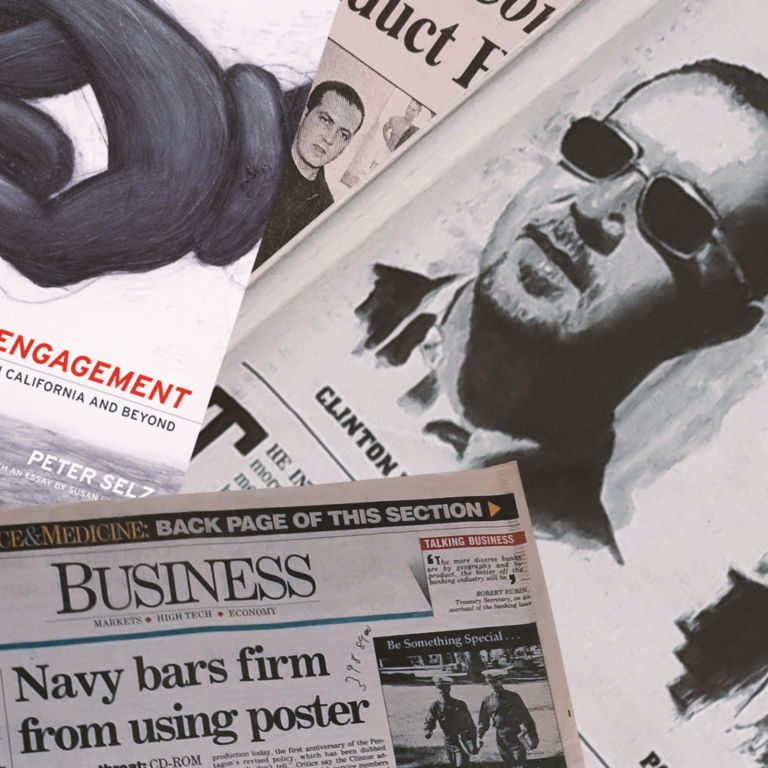
Select articles, news coverage and books from a plethora of publications covering Clinton Fein’s career as a technologist, activist, artist and speaker.
As an activist, with a Supreme Court victory over the Attorney General of the United States, Fein garnered international attention, including The New York Times, CNN and The Wall Street Journal.
Fein’s thought-provoking and controversial work as an artist caught the attention of prestigious educational institutions, including Harvard University, which recognized its socio-political relevance and ability to provoke crucial conversations about human rights, morality, and the boundaries of artistic expression.