
The Double-Edged Sword of Visibility
By CLINTON FEIN
December 18, 2025
I’ve been thinking a lot lately about the parts of myself I choose to reveal and conceal, specifically, being gay and being Jewish. These seemingly unrelated identity markers have crashed into my consciousness recently through a series of events that have forced me to confront an uncomfortable truth: I can hide both, and sometimes I do.
This isn’t some deep confession of shame or self-loathing. It’s a pragmatic acknowledgment of how I move through the world. I easily pass as straight. I just as easily pass as non-Jewish. There’s no blinking neon sign above my head, no physical characteristic that automatically sorts me into either category in strangers’ minds. My ability to “blend” is simultaneously a safety mechanism and, in some ways, a betrayal. Of myself, of my communities, and of those who don’t have the luxury of invisibility.
The math is brutally simple: the moments when I choose visibility are precisely the moments I become most vulnerable. If I wear a Star of David necklace (I never do), attend synagogue, or participate in Jewish cultural events, I’m making a choice to be seen. When I engage in PDA’’s with another man (gay or straight), display a rainbow flag (I never do), or speak openly about LGBTQ+ issues, I’m making that same choice. And in both cases, that choice comes with a target on my back.
I’m acutely aware that my ability to even make these choices comes from a place of immense privilege. Many in the LGBTQ+ community can’t hide who they are. Many Jewish people with more traditional appearances don’t have the option of blending in. For them, visibility isn’t a choice; it’s a constant, inescapable reality.
The psychological toll of this constant negotiation is rarely discussed. There’s substantial research showing that concealing stigmatized identities, even when done for safety, correlates with increased anxiety, depression, and reduced self-esteem. The very act of hiding, while protective in the moment, becomes its own form of trauma over time. It’s self-imprisonment and death by a thousand tiny erasures. These were the very reasons I came out in my early twenties.
I’ve been thinking about this paradox because of recent events that hit close to home, even though they’re geographically distant. The rising tides of antisemitism and homophobia aren’t abstract concepts for me. They’re concrete realities that have forced me to reconsider how and when I choose visibility.
The psychological mindfuck of it all is that hiding doesn’t actually make me safer. It just creates the illusion of safety. Because the people who would harm me for being Jewish or gay don’t actually care whether I personally am those things. They hate the categories themselves. My individual passing privilege doesn’t change their fundamental hatred; it just temporarily shields me from its direct effects.
Many people face far more immediate and inescapable targeting based on identities they cannot conceal. People of color, visibly trans people, Muslims, Sikhs, those with disabilities, and countless others. Their courage in existing publicly puts my occasional moments of discomfort to shame. But there’s something uniquely disorienting about toggling between visibility and invisibility, about knowing you can disappear into the majority whenever things get uncomfortable.
The attack on October 7 in Israel shattered more than a diplomatic calculation; it ruptured a worldview many had come to trust, especially in liberal democracies, that identity had become porous, that shared humanity could substitute for protection, and that inclusion itself conferred safety. The Hamas attack on Israel exposed that belief as fragile. Jewish survival was revealed once again as conditional, not because Jews had abandoned universal values, but because universal values alone do not restrain those who have decided a community is disposable. I’m not turning this into an analysis of the Middle East, or of what preceded or followed October 7.
On 14 December 2025, the first night of Hanukkah, a mass shooting occurred at Archer Park behind Bondi Beach in Sydney, Australia, as members of the Jewish community gathered openly to celebrate a holiday rooted in endurance against erasure. Fifteen innocent people were killed, and forty-one were injured. The attack struck a Jewish ritual in a public space precisely where liberal societies promise safety by default. It delivered a brutal clarity: visibility without protection is exposure. Inclusion without vigilance is not security.
This same structural truth has long been visible to LGBT communities, and is becoming unavoidable again as protections are deliberately weakened. On December 9th, 2025, in Arlington, Texas, a city that once barred discrimination against LGBTQ+ residents in housing, employment, and public accommodations, chose not to reinstate those protections. The rollback was procedural, framed as administrative caution to accommodate the Trump administration’s mandate, but its effect is existential. Rights that had existed were removed. Safety that had been assumed became conditional. The message was not theoretical: belonging can be reversed.
Palm Desert, California, close to where I spent the last ten years of my life before returning to Johannesburg, offers a quieter but equally telling example. There, a proposal from the city’s Mayor Pro Tem Joe Pradetto to remove Pride flags from city property, under the banner of neutrality and “avoiding divisiveness”, triggered fear and outrage within the LGBTQ+ community. Cowardly opportunists like Pradetto know precisely what they are doing. No one needed to claim violence for the warning to land. Symbols matter because they signal who is protected and who is tolerated only conditionally. When visibility is framed as provocation and protection as excess, the ground shifts beneath people’s feet. Safety becomes contingent on silence.
For someone who is both Jewish and gay, these are not parallel stories. They are overlapping vulnerabilities. The Bondi Beach attack demonstrates how quickly antisemitic violence can erupt in spaces once considered secure. Arlington and Palm Desert demonstrate how legal and civic protections for LGBTQ+ people can be withdrawn, not with chaos, but with calm votes and measured language. Together, they describe a single reality: precarity does not always arrive loudly. Sometimes it arrives by design.
History makes this pattern unmistakable. In 2016, a gunman walked into Pulse, a gay nightclub in Orlando, Florida, and murdered forty-nine people. Pulse was not a fringe space; it was a sanctuary. A place of visibility, joy, and community for LGBT+ people who had been told, repeatedly, that they belonged. The massacre revealed the lie at the heart of complacent universalism. Acceptance didn’t stop bullets. Visibility didn’t deter hatred. And all the thoughts and prayers afterwards didn’t undo the fact that protection had failed when it mattered most. This year, the DeSantis administration in Florida engineered the removal of the rainbow colored pedestrian crossings that were created to commemorate those lost in the Pulse massacre. Even thoughts and prayers have a sell-by date.
None of this negates universal values. Dignity still matters. Empathy still matters. Palestinian rights still matter. LGBT equality still matters. What collapses, again and again, is the illusion that values enforce themselves. October 7, Bondi Beach, Pulse, Arlington, Palm Desert — all expose the same fault line. Empathy without enforcement does not prevent violence. Neutrality without protection does not preserve safety. Universalism without structure becomes a moral afterword, not a shield.
Jewish history itself carries this uncomfortable lesson. Hanukkah isn’t just some charming holiday about miraculous oil and latkes. It’s the story of a community that secured its survival through morally complex, sometimes unsettling means. The Maccabees fought external enemies and internal assimilationists. They made choices that historians still debate. Choices that saved a people but that weren’t always pretty, palatable or ethical. That moral complexity isn’t some footnote; it’s the whole fucking point. Light and shadow coexist in narratives of resilience.
LGBT history tells the same truth. Progress did not arrive through consensus alone. It came through protest, confrontation, insistence, and the refusal to disappear quietly. Pride was born not from acceptance, but from resistance. And when protections are rolled back, whether through ordinance reversals, symbolic erasures, or legislative targeting, the lesson resurfaces: rights that are not defended are rights that can be withdrawn.
What binds these experiences together is a dangerous moral framing now re-emerging across contexts: that minorities prove their virtue through vulnerability, that defense is suspicious, that protection itself is a betrayal of shared values. Jews are told that self-defense is immoral. LGBT people are told that safeguards are unnecessary and excessive. Both are asked to trust systems that are actively dismantling their safety. This is not universalism. It is exposure dressed up as principle.
The lesson remains stark and unchanged. Survival is not an ethical embarrassment. It is an ethical responsibility. Universal values cannot live in abstraction; they require structures that hold under pressure. Visibility without protection is not progress. Inclusion without enforcement is not safety. And for those who are both Jewish and gay, the convergence of these events is not theoretical. It is lived. Values without protection are promises written in sand. Survival is the condition that makes morality possible at all.
A world shaped by empathy must also be a world prepared to defend those vulnerable enough to need it. Only then can dignity be more than an aspiration: a lived reality for every community, Jewish, LGBT and every targeted or marginalized group alike. Until then, we need to stop pretending that visibility alone will save us. It won’t. It hasn’t. What will save us is the hard, unglamorous work of building and maintaining structural protections that hold up when they’re tested, because they will be tested, again and again. Protections that reflect an understanding that communities are safest not when they are merely accepted, but when their safety is built into law, policy, and institutional responsibility.
And when those protections fail, as they did at Bondi Beach and in Arlington (though they were fortunately upheld in Palm Desert, for now, despite revealing the danger lurking), we need to be honest about what that means: not just a policy failure, but a moral one.
A society that cannot protect its most vulnerable members isn’t just imperfect but is broken in ways that platitudes about inclusion cannot fix.
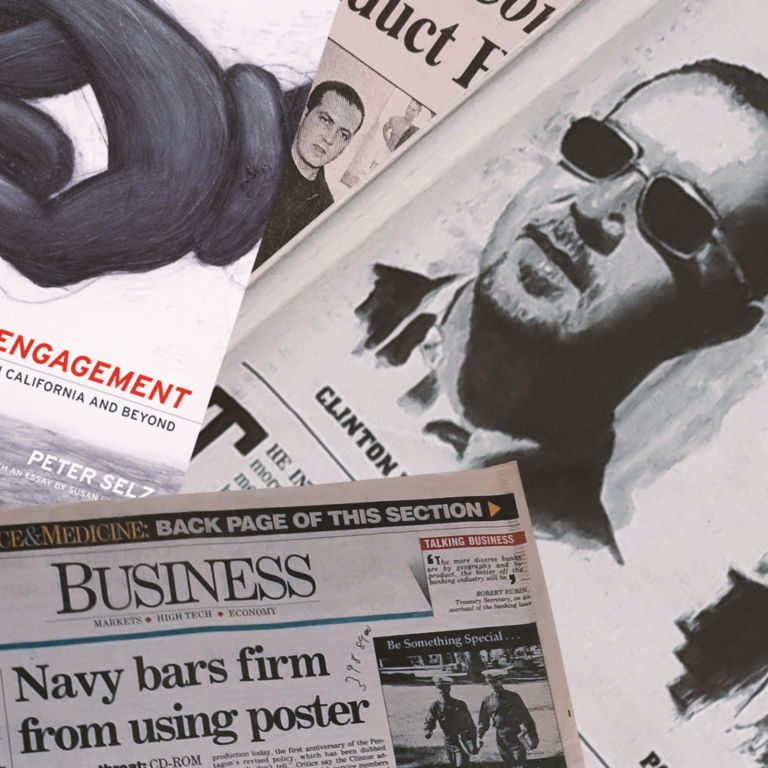
Select articles, news coverage and books from a plethora of publications covering Clinton Fein’s career as a technologist, activist, artist and speaker.
As an activist, with a Supreme Court victory over the Attorney General of the United States, Fein garnered international attention, including The New York Times, CNN and The Wall Street Journal.
Fein’s thought-provoking and controversial work as an artist caught the attention of prestigious educational institutions, including Harvard University, which recognized its socio-political relevance and ability to provoke crucial conversations about human rights, morality, and the boundaries of artistic expression.