Zapping Zazzle
Hundreds of art enthusiasts attending the opening of South African born artist, Clinton Fein’s exhibition, Numb and Number were greeted with a revised exhibition after Palo Alto-based printing company, Zazzle, destroyed two of Fein’s giant images. Fein learned of the last minute decision after a company representative informed him that two of his images had been deemed inappropriate, and Zazzle did not want to be associated with the images. The abrupt decision by the printing company altered the presentation of the exhibition and damaged the integrity of editions already released by the company.
Printing Company Zazzle Deliberately Destroys Abu Ghraib Images
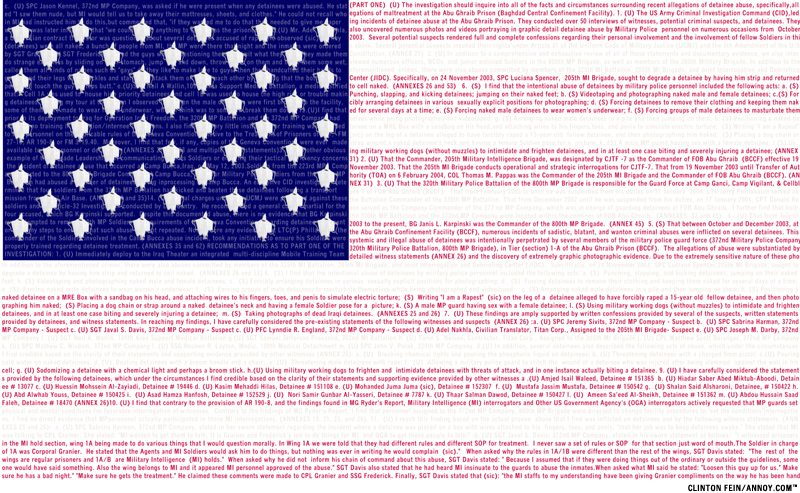
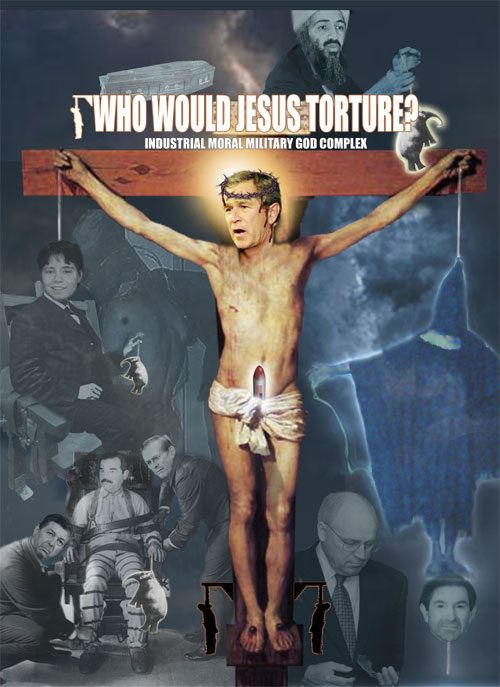
Printing company Zazzle destroyed two of Clinton Fein's images, including one depicting an American flag made from Abu Ghraib report text and another depicting President Bush on a crucifix, prior to the exhibition opening, altering the presentation and damaging the integrity of the editions already released by the company.
The printing company claimed the Abu Ghraib flag represented "excessive violence." However, the image would not have been visible or available through Zazzle, who cited a licensee relationship with Disney. The Walt Disney Company did not comment on the destruction of art by its licensees.
Clinton Fein, a prominent First Amendment advocate, criticized the printing company's actions and stated that when printers begin exercising editorial control over the content they print, standards need to be clear and consistent and that it was unfortunate a printing service felt it was more important to apply a bizarre, inconsistently applied standard to an image that nobody ever would have associated with them anyway.
A printing company named Zazzle deliberately destroyed two images of South African-born artist Clinton Fein's exhibition prior to its opening, impacting the gallery opening and angering the art community.
The company claimed that the images were inappropriate and might "offend Christians."
One image depicted an American flag with the stars and stripes made from the text of the official Abu Ghraib report, while the other showed President Bush on a crucifix.
Fein is a prominent First Amendment advocate who successfully fought against the Communications Decency Act.
Zazzle's decision altered the presentation of the exhibition and damaged the integrity of editions already released by the artist.
"It’s unfortunate that a printing service felt it was more important to apply a bizarre, inconsistently applied standard to an image that nobody ever would have associated with them anyway,” said Clinton Fein. “Particularly since they printed and then destroyed an image of mine already reviewed by The New York Times. When printers begin exercising editorial control over the content they print, standards need to be clear and consistent.”
"I don’t know what kind of statement such business practices make about academic freedom and thought in a democracy, but when a company associates itself with major brands and institutions, it needs to be very careful about the corporate image they present and the consistency of the positions they take," stated Fein, who was still weighing his legal options at the time. “This is the wrong fight to pick, with the wrong person, at the wrong time. I'd be interested to know exactly how this printer 'destroys' art."
Fein's Revenge: A Publicity Nightmare for Zazzle
2 of Clinton Fein's political works run afoul of his printer's policies, San Francisco ChronicleBad-boy political artist Clinton Fein expects trouble and regularly gets it.But preparing to open his show "Numb and Number" at Toomey-Tourell Gallery, he did not foresee that the printer hired to produce his giant, digitally manipulated graphics would refuse to release two of them. The Palo Alto printing company Zazzle scrapped two pieces respectively titled "Like Apple F -- ing Pie" and "Who Would Jesus Torture?""Like ... Pie" makes a U.S. flag from lines of the Taguba report in red on white and a blue field with white "stars" clearly recognizable as the Abu Ghraib torture victim photographed standing atop a tin container, hooded, with arms outstretched and wired.Read more
“This is one of the most widely published images of the day,” Fein told The Chronicle by phone. “For that to be the reason [Zazzle] refused to release it is beyond me.”
The second contested image shows George W. Bush on the cross, sporting a missile erection, beneath the words “Who Would Jesus Torture?”
“They said they didn’t want their name associated with my images,” Fein said of Zazzle. “And I said the only way that would happen is if they refused to print it. They said, ‘Is that a threat?’ and I said, ‘No, it’s an unequivocal promise.’ “
Matt Wilsey, speaking for Zazzle, told The Chronicle by phone, “We’re an e-commerce site where we don’t see the images until they’re printed. Clinton had uploaded some images to our site and after we printed them, we notified him that two of them violated our guidelines, and we issued a credit and destroyed them.”
The company’s publishing guidelines have been in place since its founding in 1999, Wilsey said, and take into account the fact that “We have people from 6 years old to 96 years old visiting out site, so we tried to come up (with) guidelines that would make it welcoming to all people.
“We obviously understand Clinton’s frustration because we don’t shy away from messages that are political or anti-Bush,” Wilsey said, as long as they respect certain boundaries. “We understand that Clinton wants to stir the pot, but we don’t want to be making money off that kind of content.”
Fein has fought bigger battles, he said, “but it’s not the role of a printer to decide things like this.”
He managed to get prints made elsewhere at the last minute, at the cost of some inconsistencies in presentation, so visitors to his show can decide the matter for themselves.
2 of Clinton Fein’s political works run afoul of his printer’s policies
By Kenneth Baker, The San Francisco Chronicle
November 2, 2004
Corporate Policy Leads To Political Censorship, Arab NewsThe Internet was thought by many to be the greatest hope for unfettered freedom of expression globally. However, controversial political artist Clinton Fein discovered that censorship is alive and well — even online. The December 2004 issue of ME Printer Magazine tells the tale of a printing service, Zazzle.com based in Palo Alto, California, that refused to release two images it reproduced for a show of political art at a San Francisco art gallery. Zazzle executives said the images violated company policy against depicting torture and the disparagement of religion, among other restrictions. The images were part of a show titled, “Numb & Number” which was held at the Toomey Tourell Gallery. One of the prohibited images showed a flag which contained multiple reproductions of the now infamous silhouette of a hooded Abu Ghraib prisoner standing on a tin container, holding wires. The second banned print featured US President Bush’s face superimposed on a crucified figure.Read more
ALKHOBAR, 11 January 2005 — The Internet was thought by many to be the greatest hope for unfettered freedom of expression globally.
However, controversial political artist Clinton Fein discovered that censorship is alive and well — even online. The December 2004 issue of ME Printer Magazine tells the tale of a printing service, Zazzle.com based in Palo Alto, California, that refused to release two images it reproduced for a show of political art at a San Francisco art gallery. Zazzle executives said the images violated company policy against depicting torture and the disparagement of religion, among other restrictions.
The images were part of a show titled, “Numb & Number” which was held at the Toomey Tourell Gallery. One of the prohibited images showed a flag which contained multiple reproductions of the now infamous silhouette of a hooded Abu Ghraib prisoner standing on a tin container, holding wires. The second banned print featured US President Bush’s face superimposed on a crucified figure.
Zazzle’s main business is to print and sell reproductions of artwork over the Internet. Zazzle management claimed that they didn’t actually see Fein’s images until they were printed. The company said its publishing guidelines take into account that viewers from six to 96 years old visit the site, so it must be welcoming to all. The company said they don’t shy away from printing political or anti-Bush images but that Fein’s work was not compatible with the corporate guidelines established in 1999.
Zazzle agreed that the Abu Ghraib picture had been published many times elsewhere. However, they still believed that it represented human torture. Zazzle management insisted that the prints violated the site’s user agreement on the grounds of being both offensive to religious believers and excessively violent. While the user agreement is usually specific to those who publish images on the Zazzle website, Matt Wilsey, director, Business Development, Zazzle, said the agreement also applies to cases such as Fein’s where the customer is using Zazzle exclusively as a private printing service. Wilsey said the company had refused to print other controversial images, including those of Jews in German concentration camps and the Japanese Americans in US internment camps. He added that being associated with pictures such as Fein’s was at odds with the image the company wanted to project and that it was not obligated to print the pictures.
While Fein has fought and won battles concerning freedom of expression in the US courts, on this occasion time was not on his side. He was forced to have the pictures printed elsewhere due to the imminent opening of the show. “From a constitutional standpoint there’s not an issue, but from a corporate censorship standpoint it’s an enormous issue,” Fein said the day before his exhibition’s opening.
It is fair to mention here that the Kingdom’s Internet authority has blocked local access to Annoy.com, the site of which Fein is Webmaster and some ISPs have annoy.com on their blacklist of SPAM websites. Additionally, this newspaper, as a family publication, is unable to reproduce some of Fein’s images including the Bush graphic rejected by Zazzle.
That said, it should be noted that it was possible to locate Fein’s “Numb & Number” images through local ISP access. Fein’s pictures weren’t pretty and some were very hard hitting, but they were worth a second look. Whether an individual found agreement with Fein’s images or not would of course be a matter of personal interpretation. What is a fact the world over is that even in this Internet Age, freedom of the press is for those who actually own one.
Corporate Policy Leads To Political Censorship
By Molouk Y. Ba-Isa, Arab News
11 January, 2005
Artist and advocate Clinton Fein has his controversial images destroyed prior to exhibition, Art
ThrobCalifornia-based, South African born artist and advocate Clinton Fein recently had an unbelievable experience, especially for an ardent defender of the first amendment. Fein had an exhibition at Tommey-Tourell Gallery in San Francisco on October 14. Just prior to its opening he learned that printing company Zazzle had deemed two of his images controversial and not only failed to print them, but destroyed them as well. The result was a frenzy to try and compensate for the absence and an unavoidable inconsistent presentation of the artist's work at the opening. The two offending images were titled Like Apple F-ing Pie and Who Would Jesus Torture?. The first work was a U.S. flag with stars that clearly depicted an Abu Ghraib torture victim. The second showed George W. Bush on a cross with a prominent erection. In an attempt to disassociate themselves from these images, Zazzle declared them inappropriate and failed to print them for the artist. Little did they know who they were defying when they chose this course of action. Noted for successfully challenging former Attorney General Janet Reno in a case that went to the US Supreme Court, Fein was not deterred.Read more
Instead of avoiding publicity, Fein ensured that is exactly what Zazzle got – particularly negative. The artist brought into question the ethical nature of Zazzle’s actions and the problems that arise when printers exercise editorial control. As Fein said, ‘It’s unfortunate that a printing service felt it was more important to apply a bizarre, inconsistently applied standard to an image that nobody ever would have associated with them anyway.’
Ironically one of the very images Zazzle destroyed was recently reviewed and printed in the New York Times, and the image of the Abu Ghraib torture victim has already been widely disseminated by the international media.
While Zazzle has previously printed controversial imagery, their decision here was made more problematic by the fact that Fein had not granted the company permission to use the images, attach their name to the work or release information about the work – essentially ensuring they would avoid any association.
Zazzle has previously printed a reproduction of a Library of Congress photograph of hanging hooded bodies of the four conspirators who assassinated Abraham Lincoln, but cited its position as a licensee to Disney as the reasoning behind destroying Fein’s images.
Fein has not decided if he will take legal action in this case, but has been quoted as saying, ‘I don’t know what kind of statement such business practices make about academic freedom and thought in a democracy, but when a company associates itself with major brands and institutions it must be very careful about the corporate image they present and the consistency of the positions they take.’
The exhibition is on view at the Tommey-Tourell Gallery until November 13. If you happen to be in the Bay area have a look and let Art
Throb know what you think about the decision by Zazzle to destroy.
Artist and advocate Clinton Fein has his controversial images destroyed prior to exhibition
by Kresta Tyler Johnson, Art
Throb
November 4, 2004
Print shop refuses to release political images, Mercury NewsA printing service in Palo Alto has refused to release two images it reproduced for a show of political art scheduled to open this week at a San Francisco art gallery, saying they violated company policy against depicting torture and the disparagement of religion. The printing service, called Zazzle, informed artist Clinton Fein on Monday that it would not release two of six images for "Numb & Number," an exhibit of Fein's deliberately provocative political art scheduled to open this evening at the Toomey Tourell Gallery at 49 Geary St.Read more
The first of the two images is of an American flag with the now infamous hooded figure of an Abu Ghurayb prisoner substituted for the stars. The second features President Bush’s face superimposed on Jesus’ on the cross. Over the Christ figure are the words, “Who Would Jesus Torture?” and, “From the Industrial Moral Military God Complex.” That image also contains a missile positioned as a phallus.
Matt Wilsey, director of business development for Zazzle, said the company’s guidelines, which are posted on its Web site (www.zazzle.com), prohibit depictions of “excessive violence” and “derogatory references about religion” among other restrictions. Zazzle’s primary business is to print and sell reproductions on the Internet. It allows customers to post their images there for resale and a small commission.
Wilsey acknowledged that the guidelines are primarily intended for those who publish images on the Zazzle Web site, but said they also apply to cases like Fein’s where the customer is using Zazzle exclusively as a private printing service. He said being associated with images such as Fein’s is at odds with the image the company wants to project and that it was not obligated to print them.
But Fein has cried censorship and speculated that the printer doesn’t want to offend the Hoover Institution, a conservative think tank located at Stanford and a major partner of Zazzle, which publishes posters from the Hoover collection via the firm’s Web site. He said the public never would have known who had done the printing had they not made an issue of it.
Even if another printer can complete work on the withheld images in time for the opening, Fein said, the work probably wouldn’t look exactly like the work Zazzle did. He said he intended to post a notice on the gallery wall to explain what happened.
Fein, a native of South Africa who has said he moved to the United States for its protections of free speech, is no stranger to censorship controversies. It was Fein who created Annoy.com, a provocative political Web site, in response to the passage of the 1997 Communications Decency Act, which made it illegal to send communications over the Internet that are “indecent” with “intent to annoy.”
Fein lost a subsequent bid to overturn the act by suing then-Attorney General Janet Reno, but the suit did manage to get the statute redefined so that offensive and annoying communications remain a form of protected speech online.
“I know this stuff is in your face,” Fein said. “That’s the point. My philosophy is you need to stir people from apathy. In my opinion, political statements in art should not be sugar-coated.”
Print shop refuses to release political images
ART VIOLATES POLICIES, PRINTER SAYS ABOUT SHOW PIECES
By Jack Fisher, Mercury News
October 6, 2004
Printer rebels at artist’s imagery, Los Angeles TimesA printer for Clinton Fein, who once sued then-Atty. Gen. Janet Reno, has refused to produce two images by the political artist for a San Francisco gallery show. The Palo Alto-based printer, Zazzle, said the images violated company guidelines. One image depicts an American flag -- the stripes are lines of text from the so-called Taguba report, while the stars show a hooded Abu Ghraib prisoner. The other image shows President Bush crucified with a missile between his legs. “If Gutenberg hadn’t printed Martin Luther’s Bible, there wouldn’t have been a Reformation,” said Fein, who found another printer for his show, “Numb and Number,” at Toomey Tourell gallery. “We don’t need printers deciding what’s appropriate content.”,Read more
Matt Wilsey, director of business development at Zazzle, said company guidelines ban images of excessive violence as well as derogatory references to religion. Fein’s flag image “contains the image of torture,” while the other image is “offensive to Christians,” he said.
Fein created Annoy.com, a provocative political website, protesting the 1997 Communications Decency Act that made it illegal to send Internet communication that is “indecent” or has “intent to annoy.” He sued Reno to overturn the act but lost. The statute, however, was redefined: Annoying communication remains protected speech online.
Printer rebels at artist’s imagery
By Louise Roug, Los Angeles Times
October 13, 2004
Tussle over political poster pits Net free-speech veteran against online print shop, CNETAn online free-speech activist is finding that even on the Internet, freedom of the press is for those who own one. As Webmaster of Annoy.com, Clinton Fein once successfully challenged the federal government's online obscenity restrictions. In his new incarnation as a political artist, Fein now claims he's being muzzled by an online print shop that refused to print two of his works. "From a constitutional standpoint there's not an issue, but from a corporate censorship standpoint it's an enormous issue," Fein said the day before his art opening at San Francisco's Toomey Tourell gallery. "It's not the role of printers to define the content of an artist."Read more
Zazzle.com, a Palo Alto, Calif., online printing service, on Monday declined to release two of 10 prints Fein submitted last week. The prints in question criticize the treatment of Iraqi prisoners by the U.S. military.
The company made its decision after determining the prints violated the site’s user agreement on the grounds of being both offensive to religious believers–in this case Christians–and excessively violent.
“The reason our QA staff decided to prevent distribution is that we have very clear guidelines, and we don’t want to produce images of torture,” said Zazzle vice president of business development Matt Wilsey. “We don’t have a problem with political messages, but even if (the picture from Abu Graib) is iconic, it does represent humans torturing each other.”
One of the images in question pictures an American flag whose stripes are replaced with the text of a U.S. military report on the abuse by U.S. soldiers of Iraqi prisoners at Abu Graib, and whose stars are replaced by the image of a hooded prisoner standing on a small box and holding up wires.
Another shows a crucified President Bush and asks, “Who would Jesus torture?”
Wilsey said the company had refused to print other controversial images, including those of Jews in German concentration camps and the Japanese Americans in U.S. internment camps. He said Zazzle “occasionally” took heat for those decisions from clients like Fein.
Zazzle, incorporated in 1999 but not launched until last year, is one of a handful of online print shops tapping a market of artists, political candidates and activists, merchants and ordinary consumers who want the convenience of on-demand printing services and the potential to set up individual online stores hawking printed products.
Fein said he is still weighing his options with respect to Wednesday’s exhibition opening and is considering legal action against Zazzle on breach-of-contract grounds.
While Zazzle’s name is not attached to Fein’s prints, the company said it is working to build its brand as a “family Web site.” The company is a Disney licensee and maintains a ratings system to cordon off certain kinds of content displayed and sold on its site.
“We wish Clinton the best of luck and support his right to express his message,” Wilsey said. “We just don’t want to produce it.”
Annoy.com Webmaster says war art censored
By Paul Festa
CNET, San Francisco
October 18, 2004